Philly stylists look back at boldest (and tackiest) suits from the 2003 NBA Draft

A lot has changed in the NBA over the last two decades.

There’s no longer a team in Seattle, despite the outcry from grieving Supersonic fans. A generation of “big men” have morphed into position-less perimeter threats, and the Denver Nuggets are NBA champions for the first time in franchise history. Oh, and there’s a new all-time leading scorer in LeBron James, who passed Kareem Abdul-Jabbar’s record back in February.

In the past 20 years, records have been shattered, new superstars have emerged, and college prospects are landing million-dollar brand deals before stepping into an NBA arena. But the hype around the NBA draft has remained. And on Monday, it will be 20 years since James, Carmelo Anthony, Chris Bosh, and Dwyane Wade’s names were called on draft night.

The 2003 NBA Draft is considered one of the greatest draft classes in league history. Not only were there four future Hall of Famers picked in the first five slots, but All-Star players Chris Kaman, Josh Howard, David West, Kyle Korver, and Mo Williams were also among the crop. But for all its glory, fans are convinced the ‘03 class is the worst-dressed group ever seen on draft night.

From the mountainous shoulder pads, overly buttoned suit jackets, curtain-length pants, and bulky silhouettes, Philly style blogger Sabir Peele said that year’s draft reminds him of Sunday service in the 1990s.

“The suits looked okay, but they had 16 buttons and a regular shirt collar on their jacket,” Peele said. “It was like people were dressing for what their perceived size was or something their grandfather might have worn, but not for their actual body. I don’t know who let them walk out the door thinking this was hot.”

While some fashion choices appeared inexcusable, Peele said, there were other layers worth considering: Hip-hop had a big influence in fashion during that era, and the presence of social media was largely nonexistent at the time. Neither Facebook, Twitter or Instagram existed in 2003, which likely forced the incoming rookies to rely on family members or friends for guidance. The result: “Just some big a** clothes.”

“Some of it has future application, but in terms of the actual design and cyclical-ness of the fashion, I don’t think this is going to come back,” Peele said. “Back then, there was no silhouette or shape.”

In an interview with Bleacher Report, Wade said players like Allen Iverson influenced his decision on draft night. “At the time, hip-hop culture was baggy jeans, Sean John jeans, hats to the side — that was the Allen Iverson culture,” the former Miami Heat star said. “That’s where the NBA was when we first got in.”

Even No. 10 pick Jarvis Hayes, who Peele said was dressed like a Baptist deacon, regretted the size of his draft suit. “It was the baggy suit era,” he told Bleacher Report. “I got (my suit) from a close family friend out in Georgia. I doubt if they’re still in business now if they’re still making suits like that. You wouldn’t catch me dead in a suit that size.”

Philly stylist Wayne Glassman, who owns Wayne Edwards Workshop, said the relaxed tailoring of the early 2000s was vastly different from the stylings of today, which favor more cropped, form-fitting looks with softer, more complementary colors.

“The players were just following the trends at the time,” Glassman said. “They had wide lapels with lower gorges. The pants were high-waisted, which allowed for a lot of drape, and there was fullness throughout the entire silhouette. Compared to today’s silhouettes, the trim is so much nicer.”

Looking back, Glassman said it’s easy to laugh at the suits worn by James and Anthony, but he’s seen younger athletes like Trae Young make similarly head-scratching fashion choices for the draft. “When he got drafted, (Young) wore a suit with cropped pants I’m not sure came down below his knees,” Glassman said. “He had on leather shoes and no socks.”

Glassman said certain athletes dress on the “costumey” side, while others take calculated risks to stand out. Then there are players and ex-hoopers who completely abandon the rules of fashion, he said.

“Guys like Reggie Miller are pretty dapper, but if you look at someone like Charles Barkley, apparently others don’t care,” Glassman said. “Even sports broadcasters like Jeff Van Gundy, his suits look terrible. It’s really up to these athletes to put in the effort.”

With the presence of social media, and the popularity of tunnel walk photo ops, Peele said more athletes are leveling up their fashion sense. Instead of hiding their physiques under oversized jackets and lengthy trousers, players are opting for more natural-fitting garments. Some still pull out traditional suits, but the “blazer 2.0″ has become a more popular choice, he said.

“More guys want to be known as the ‘well-dressed athlete,’” Peele said. “Some come out suited, but others don’t want to be buttoned up, so they’re not wearing ties anymore. They’re thinking, ‘How can I flex and show that I’m still put together.’ I feel like that has become the thing.”

Players are trading in classic suit pieces for tailored pants and trucker jackets, and exchanging neckties for flashy necklaces and diamond-studded pendants. And as cyclical as the fashion industry can be, Peele doesn’t see the parachute suit pants or six-button jackets making a return.

– The Philadelphia Inquirer

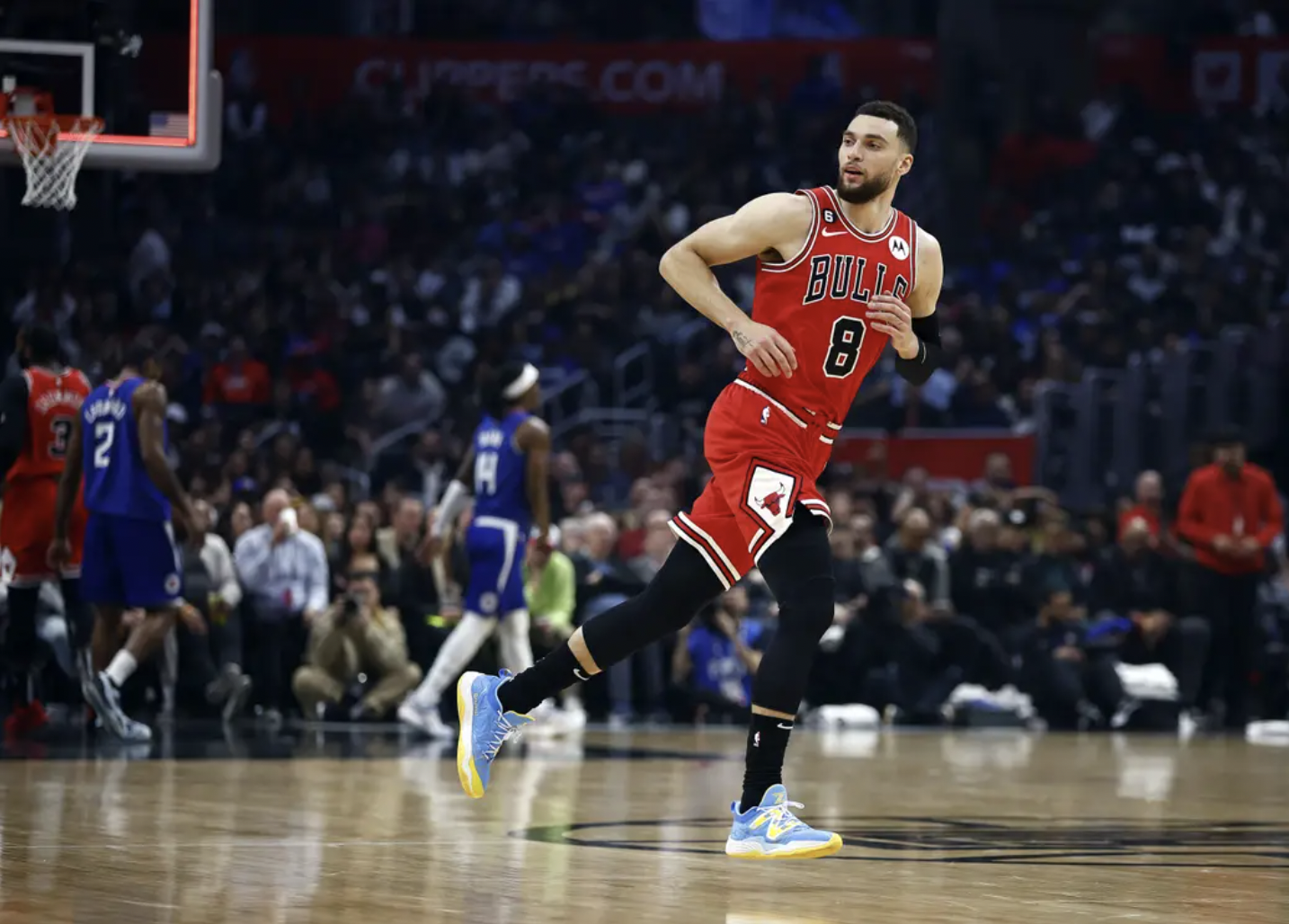
New Balance Basketball Stars Tyrese Maxey, Zach LaVine, and Dejounte Murray Talk Street Ball Origins

From its inception to today’s game, generations of basketball stars have conjured their hoop dreams on neighborhood blacktops, rec center gym floors, and makeshift home courts. Others made their name in different sports before discovering their on-court talents during gritty pickup games and street ball tournaments.

Those moments on the hardwood or cement floors defined their future play styles. They learned how to flick their wrist on their jump shots; kiss the top of the backboard on reverse layups, dunk over contested hands, and meld their skills and passions together to create their legacy – the same tireless pursuit of perfection that  New Balance has applied to decades in the footwear game.

Since 1906, New Balance has focused on being makers rather than marketers. They’ve  prioritized craftsmanship and impact over hollow accolades and fleeting moments of recognition and engagement. With the quality of its products, materials and partnerships, the brand has established an independent voice in the conversation of sports and culture, while inspiring a growing community of patrons proudly donning the letter “N” on their kicks. 

From the playground to arenas, big-name talents like Tyrese Maxey, Zach LaVine and Dejounte Murray have been drawn to the New Balance brand and its connection to street basketball culture. These hoopers talked to Complex about their early experiences on their hometown courts and how those memories inspired their game and style today. 

Tyrese Maxey

Getty Images

Before Tyrese Maxey became a first-round draft pick, the Dallas native was outplaying hoopers his own age. He was running the baselines as early as 4 years old, and there wasn’t a place in the world with a ball and a hoop he didn’t want to showcase his basketball talents. “My father was a head boys’ basketball coach, and I would go to practice with him and play. If I couldn’t go with him, I would go to the park in my neighborhood and play or force my uncle to play with me,” he says. 

Under his father and uncle’s wing, he began learning the nuances of the game, and the two men shaped Maxey’s fast-paced and creative playmaking style and instilled his confidence off the court. That growing conviction allowed him to embrace the resistance of elevated competition, and it opened his mind to the benefits of street and recreational ball. “Pickup games and structure-free basketball teach you how to improvise and give you a better feel for the game,” Maxey says. “Pickup games bring out a different level of competition; guys are going at you, and they have much to prove.” 

Now, the 22-year-old scorer wants to give aspiring hoopers in Philly the same experience he had in his youth. By pouring into the city’s parks and recreational centers, he feels it will increase community engagement, round out young players’ games and inspire others to capture the grit and relentless attitude he adopted on Dallas’ outdoor courts. “It’s extremely important; it’s the blueprint of basketball; it connects you with the people from all walks of life within the basketball community,” the University of Kentucky product says. “It builds a different layer of toughness. I’ve recently started to connect with some of the public park leagues here in Philadelphia; I’m looking forward to working with them and seeing what I can do to help push and keep the culture moving forward.”

Dejounte Murray

Basketball always came easy to Dejounte Murray. He dropped 35 points in his first rec league game, and did so well, he was convinced the rims were too low. Fortunately, he was wrong, and that day foreshadowed his future career as a professional athlete. 

Like Maxey, the Seattle native’s coronation into the sport was through his uncles, who made a hoop out of laundry baskets to play basketball indoors. Outside the house, Murray says they played on two hoops with missing backboards, and he followed his uncles wherever else they spotted a suitable court and competition. “I played everywhere my uncles played, which was our house, school, churches, and local outside courts,” Murray says. 

By competing in outdoor pickup games and rec leagues, the former University of Washington star found his love for organized ball and street hoops, and recognized the need for both forums. Murray said it toughens the skin of players. “Streetball is so important because it allows you to fall in love with the game of basketball, hooping freely and competing harder than ever, so I definitely believe it’s really important and it produces the best hoopers,” he says.

Between pro ball and streetball, Murray almost prefers the freedom he felt on the playgrounds and rec gyms he played on as a kid. The 26-year-old defensive stopper says he’s excited to see the best streetballers between Seattle and Atlanta, and his plans to return to the blacktop might be in the cards this off-season. “Streetball is the real deal. I prefer that hoop more than anything, and the league is the league; [it] turned my dreams into reality, and [me] proudly representing my family,” he continues. “In the off-season, I’m training and playing with my teammates at our practice facility and even outside too. But sooner rather than later, I want to take my 5 and go play against some of the local best in Seattle and Atlanta.”

Zach LaVine

For player Zach LaVine, his early streetball days didn’t begin on an actual street. In fact, not even above ground. Instead of a nearby park, rec center, church or playground, his professional athlete aspirations first bloomed in the basement of his childhood home. Before the high-flying scorer was in Pre-K, his dad set up a hoop and backboard inside the underground space. 

From an early age, the two-guard was destined for a career in sports. His mom was a softball player in college and his dad played football professionally as a linebacker. But after trying his hand at different sports, basketball quickly rose up the leaderboard, and he traveled wherever his newfound passion took him. “I played everywhere, from local parks and rec centers to high school tournaments,” the two-time All Star says. “On weekends my mom, dad, and sister would drive around looking for different parks that had different nets and rim heights.”

As he traveled around and beyond the suburb of Renton, Washington, LaVine said the experiences sharpened his game and focus, and prepared him for the physicality he would later face in his college and pro career. “Whenever you’re a young athlete, it’s good to learn how to compete in a team sport; It teaches leadership, toughness, and sportsmanship,”“ he says.

LaVine said the playground and local rec centers are where the game feels the purist, so it’s no surprise most players cite their hometown courts as the place they found their passion for basketball. Some of his fondest memories were playing alongside his dad in pick up games, who would elevate over YMCA hoopers long before LaVine was posterizing power forwards and centers. Looking back, the former UCLA standout says those experiences are valuable for any young basketball player. There are people of all different sizes and various skills when playing pickup games. Not only did that enhance the versatility of my game, but it taught me always to stay ready,”LaVine says. 

– COMPLEX for New Balance

6lack Feels Good To Be Back In Motion

In the five years since his last album, 6lack has been on a voyage of rediscovery. While hits like “Ex Calling” and “Prblms” established his penchant for moody and atmospheric tales of heartbreak and loss over mid-tempo jams, the East Atlanta artist has taken on a new creative direction.

Veering from his grayscale vocals and mellow-tone raps, his new album, Since I Have a Lover, unlocks a chamber of new inspiration both musically and on his own personal journey.

“Time has been a little bit of a loop,” 6lack tells MTV News over Zoom. “It was a lot to learn. It was a lot to handle in my personal life. It was a lot to mature and grow from. And I think that the weight of having people waiting on you is something that you can't really ignore. It's not like it doesn't exist, so it feels great to have that weight off and to just be back in motion.”

On Since I Have a Lover, the airy vocals of the artist, born Ricardo Valdez Valentine Jr., float over breezy, pop and acoustic-driven instrumentation on “Chasing Feeling” and “Wunna Dem,” and 6lack flirts with dance (“Temporary”) and wallows with Caribbean, beach-front tunes on “Decatur,” allowing his artistry to roam free.

“I think it's been super important to grow in between each project, and not even just musically, but personally,” he said, referencing the “moody” tenor of his 2016 debut, Free 6lack. “It felt like somebody trying to figure their way out of the situation, and East Atlanta Love Letter started to peek at where we could go with it within the realms of R&B. I think this album production-wise allowed me to express every feeling that I feel. Some days I might feel more pop or [alternative], and some days I might feel more traditional R&B or rap. It varies and it kind of plays to how relationships vary — everything isn't just one feeling or one color.”

The 19-track offering is an exercise of 6lack’s versatility. He melds inklings of his Atlanta trap roots with guitar-strumming and flowy tracks, all revolving around themes of self-healing (“Spirited Away”), positivity, and the mystifying powers of love on “Preach” and “SIHAL.”

For 6lack, this new direction was a “gradual blossom.” While there were cookie crumbs on 2020’s 6pc Hot EP that pointed to this more immersive effort, the Baltimore-born artist said the new album’s title, partly inspired by his relationship with R&B singer Quin, helped spark a new flame. It also drove him to create an open letter to his fans, which he hopes answer the questions that have loomed in his musical absence.

“I feel like the title more than anything it’s a response,” 6lack said. “It kind of serves to answer every question. Like, ‘Where have you been? What have you been doing? What's the theme? What's been inspiring you the most? Why haven't you been outside?’ Any question that you could possibly ask me, I think ties back to the title Since I Have a Lover. Having to be accountable for yourself is one thing, but having somebody next to you who can really look at you and see you for what you do right and what you don't do right and tell you just a hundred percent straight up, that helped me really hone in on where I wanted to be in my personal life and where I wanted to be creatively. It was like, ‘OK, I got to get my shit together. And once my shit is together in my personal life, then I know that will help inspire what I make music-wise.’”

But the shift was no easy feat. To embrace his new sound, he had to let go of the sorrow, regret, and heartache he internalized for Free 6lack and his romantic skepticism and stories of failed love quests that bled into his second effort. Once those thoughts were steered, once he focused on the treasures of his newfound relationship, and once he waived his past transgressions and mental blocks, 6lack sank into a new music-making paradigm, and the album poured out and turned into sonic gold. On “Spirited Away,” he says: “You know I got my vices, on the real / No, I ain't always nice, but I’m always real / It’s gonna take me some time to break off my pride / But I’m learning to show up, learning to slow up.”

“The process was only hard when I was resistant to change and to acknowledge that my life is different now,” he said, referencing how he’s stopped letting others’ perception define his personal and artistic growth. “I’m not sulking, I’m not depressed, and I’m not going through what I went through in 2016. If you even try to start a song that way, you might as well stop because that's just not it. And if you continue, that's what we call perpetrating, and I'm not here to portray anything for a specific award or category. I just want to make what's true to me.”

6lack’s sonic transformation was one he felt both he and his fans needed. In a world where negativity draws headlines and tilts the algorithm on its scale, the 30-year-old artist said it’s his responsibility to share notes of positivity. And on Since I Have a Lover, he never falls short of his mission.

On “Preach,” he raps: “Who am I to capitalize without giving back? / We all human but I can’t go a day not feeling Black / I made my money, but to my audience, I’m still attached / It’s like I know the whole world just wants that feeling back.”

“I think that the toxic theme has been populated and I think that it is honestly a lot easier to pull from depression, from heartbreak and breakups. And to me, that's easy,” he said. “It's harder to talk about good things. It's harder to make that translate or resonate with people. It is harder to make that sound cool. The world is only getting crazier, so if I can be at least a portion of the good that's coming out, then that's my job.”

His exploration doesn’t end with SIHAL. Along with feeding his current inspirations, the “Float” artist plans to collaborate with Quin, the very lover that inspired the new album title, and possibly lock in with Spillage Village group-mate JID for an upcoming collab project.

“I'm just going with the process, but I hope it continues to be something different,” he said. “I don't ever want to make the same album twice. I don't want to be in the same bag twice. I'm not telling the same story twice. There will never be a Free 6lack 2 unless I end up in a situation that puts me there, and let’s hope I don’t have to because that’s not what we’re looking forward to at all.”

– MTV News

Breaking barriers and opening doors: Philly artists are finding new spaces to showcase their creations

Few spaces are as essential to Philly arts as the city’s history-rich museums and art galleries. The institutions house some of the most prized artifacts and antiquities in the country, and serve as a domain for unknown artists to become international fixtures.

But for Lauren Fiasconaro and other Philly-based creatives, the barrier to entry is often too steep, forcing many artists to turn to local cafés, restaurants, bars, and other alternative spaces to showcase their artwork.

“This is definitely something that’s been cropping up more and more,” said Fiasconaro, 30, who’s currently displaying her cyanotype photography at Northern Liberties’ Mammoth Coffee. “More than half of my ideas came from seeing artwork in places that I wasn’t expecting, and there’s some amazing work in places and venues you wouldn’t expect.”

Philly sculptor Jonathan Santoro, 39, said local artists have taken matters into their own hands.

“Groups of artists are growing tired of white cube galleries and rejecting the status quo while being intentionally anti-commercial,” he said. “More artists are taking the reins and displaying their artwork how they want.”

Rather than wait for spots to open at established art institutions, artist Sue Moerder began hosting small showcases in hair salons, restaurants, bars, and even pet shops under the group philacitywithart. She started the 500-member Facebook page to forge more opportunities for local artists to display and sell their work without having to jump through hoops to get into galleries and museums.

Moerder, who makes sculptures from animal skulls, said the city is flooded with local talent, but the exclusivity of certain spaces has led many artists to seek other ways to sell their work and make ends meet.

“Galleries are great, but they’re very hard to get into,” Moerder, 62, said. “I think one of the harsh realities of being an artist in Philadelphia is that many people can’t survive solely doing their art. Most have to work to support it, which is a shame because there are too many talented artists. And when you’re exhausted and you’re mentally drained, it’s hard to create. It’s frustrating.”

Recognizing the shortage of accessible art spaces, Gleaner’s Cafe owner Stephen Hencheck fills the shop’s walls with the work of local artists as a way to spotlight the city’s talent and build the confidence of newer creatives hesitant to display their designs.

With the cafe’s name partially inspired by Jean-François Millet’s painting The Gleaners, Hencheck said the decision to add these works was an important one. Not only has the move drawn more eyes to local artwork, it’s helped struggling artists fully profit from their creations, rather than fight for higher commission splits in more traditional spaces.

Hencheck allows creatives to fully profit from their work, while more notable galleries have commission splits that teeter between 30% and 50%, he said.

“We just try to keep a starving artist from starving so we can look at their work,” Hencheck, 44, said.

“If your business is your community, you should make it your business to support that community. That doesn’t apply to everyone, and it doesn’t have to. If creativity and culture are what you believe your base is and what makes the neighborhood your business is in, why wouldn’t you try to support that?”

Through partnerships with nearby galleries, the Fitler Club is combining the influence and resources of established spaces to fuel its own alternative venue.

The urban social club has Philly-made pieces throughout its center, a move Visual Arts Director Tricia Maloney said has connected the club’s members to the city’s creative forces, and given more local artists a platform to spread their wings.

“Our hope is that there may be a lower barrier to entry to engage with the art in a place like the Fitler Club,” Maloney, 41, said. “It’s not a gallery — we tried to take that intimidation factor out of the equation, even to the extent that I coordinate the program and I don’t have an arts background. It’s really about relationship building.”

Fitler Club cofounder Michael Forman said the addition of alternative art spaces doesn’t diminish the importance of established art institutions in Philly. It’s an added way to support local creatives and place a brighter spotlight on the work they produce.

Along with the Gleaner’s Cafe and Fitler Club, Fiasconaro said venues and organizations like Persimmon Coffee, Underground Concepts, and Feminist Flea are opening doors for artists in the LGBTQ and Asian American and Pacific Islander communities, as well as others that have been marginalized by their race, ethnicity, sexuality, and identity.

Having these spaces, Fiasconaro said, is key to a more inclusive and well-rounded arts scene.

“Historically, gallery spaces are and can be very inaccessible for a lot of people,” she said. “I have definitely encountered that as well. But I’m seeing more inclusivity in this trend of alternative spaces, which is amazing. It’s been a long time coming.”

Fiasconaro is hopeful more opportunities for artists of all creeds will open up in museums and galleries. And as Philly creatives continue to carve out nontraditional platforms, the artists and businesses receive the support they deserve.

– The Philadelphia Inquirer

Resetting the metronome: Philly beatmakers build community through monthly meet-ups

Dan Brightcliffe knows the isolation of beatmaking. All the hours spent fixed to an MPC drum machine or needling through sample packages on a laptop can be grim even for the most withdrawn of producers.

To forge a culture of collaboration, Brightcliffe, 33, and fellow producer Quinton “Q No Rap Name” Johnson, 30, host Flipabeatclub, a monthly beatmaking event that is generating buzz and building community in Philly’s music scene.

Since August, Johnson and Brightcliffe have drawn producers to Cratediggaz Records to create hip-hop, house, and electronic beats in tandem. Some dig into their vinyl collection, and others use computer programs or phone apps, but what brings them together is their love of beatmaking and eagerness to connect.

Philly’s FABC looks to reset the metronome by bridging the gap between artists and producers, and expanding the club’s reach beyond the city’s borders.

“There really hasn’t been much of an outlet for people who make sample-based music,” said Brightcliffe, who produces under the name “Philth Spector.” “It seems like there’s a slight disconnect between the people who make beats and the people who rap, which is one of our goals outside of just giving producers a platform and a network to create.”

Dan “Philth Spector” Brightcliffe (standing far right) checks the progress of the beatmakers during the Flipabeatclub monthly beatmaking event at Cratediggaz Records, 711 S 4th St., Phila., Pa. on Fri., Jan. 20, 2023.Read moreELIZABETH ROBERTSON / Staff Photographer

Producer Matt “$LiMs” Leahey, who has been a part of the Philly club since its inception, said FABC is etching a path for beatmakers who create boom-bap and lo-fi tracks, and veer away from the trap-heavy sound of mainstream rap. The monthly meetups are also big for Philly rappers, many of whom haven’t caught the same gleam as artists in other cities with hip-hop influence.

“I think [FABC is] really important because Philly doesn’t have much of a hip-hop scene in the same way that Atlanta, New York, or L.A. [does],” Leahey, 21, said. “Most rappers in Philly that I’ve seen come up in the last decade — except for superstars like Lil Uzi Vert, Meek Mill, and others — don’t really break out of Philly.”

Leahey said the same problem goes for the local beat scene. But with the presence of FABC, he’s confident things will turn around.

Bob Fisk, who owns Cratediggaz, said FABC is the grounds from which producers can perfect their craft and form connections with Philly rappers, songwriters, and singers. And in time, breathe new life into the city’s soundscape.

“There’s so much talent in the city, it’s crazy,” Fisk, 39, said. “There’s always been the existence of it. New York had the clubs, but we always had the talent.”

At each meetup, club members craft a beat from a chosen sample, then play their records on a Zoom call with FABC chapters in L.A., Toronto, D.C., and Sacramento. And at the end of each month, their beats are packaged as a compilation and released on Bandcamp.

The Sacramento club is helmed by FABC founders Donell McGary and Armando Montesinos, better known as “Dibia$e” and “Mon$rock,” who started the beatmaking network in November 2021.

Back then, only a handful of creatives met at Sacramento record store Twelves Wax for a session. But after a surge in COVID-19 cases, McGary and Montesinos moved the sessions to Zoom, which quickly drew in viewers like Brightcliffe and others from countries as far as Tasmania and Turkey.

“Being a hip-hop producer has always been guarded, like you don’t share your secrets,” said Montesinos, 43. “But it’s important to spread love, connect with people, and have those interactions.”

One of the club’s original members was Johnson, a Dallas native, who used to drive from Vallejo to Sacramento to make beats alongside McGary and Montesinos when he lived in the Bay Area. Before he moved back to Philly, Johnson talked to Montesinos about bringing the FABC brand to the East Coast.

Quinton “Q” Johnson of Phila. (right) gets Gregory Bissell of Phila. set up so he can broadcast his beat during the Flipabeatclub monthly beatmaking event at Cratediggaz Records, 711 S 4th St., Phila., Pa. on Fri., Jan. 20, 2023.Read moreELIZABETH ROBERTSON / Staff Photographer

Johnson, unsure of the new chapter’s direction, met Brightcliffe at the first event in Philly, and brought him on as a cohost. Inspired by the Sacramento club’s success, Johnson wants to bring Philly’s beatmaking sessions to a live audience.

“They built like a Wu-Tang of beatmakers out there,” the Mount Airy resident said. “I don’t know if it was planned this way, but now they have built up a lineup if they ever want to do a show … Our plan is to do something similar.”

Philly FABC member Gregory Bissell, 29, said he saw the chapter’s growth in attendance and impact after just three meetups.

The Louisville, Ky., native, who started making beats in 2020 to pass the time in quarantine, said the club’s beatmakers have already collaborated on shows with local artists. And with more members, showcases, and meetups outside Cratediggaz, he believes the music scene can reach new heights.

As FABC looks to stretch its reach even further, McGary, 46, said Brightcliffe, Johnson, and other chapter leaders just need to stay the course.

“There’s a five-year plan,” he said. “If we do this, and we do it well for the next five years, it will do wonders. It’s only going to magnify.”

– The Philadelphia Inquirer

No fade on prices: Why Philly barbers are charging $100 and up for haircuts

Kenneth Carruth IV, the North Philly native known as The4thKen on social media, has made waves (literally) with his haircut tutorials and videos. The 20-year-old barber has amassed more than 1.8 million likes on TikTok, with his biggest video reaching over 2 million views. But it’s not always his clean lines and tight fades that are attracting attention.

In one video, Carruth showed off a mid-fade and noted, “My client paid me $80 for this haircut.” Other videos list prices well above $100. While some viewers were in favor of the price tag, others called the haircut a “scam” and wrote how their barber could do the same job for $15.

Before the COVID-19 pandemic, Carruth also charged $15 per head. But with more demand, and the rising cost of running a business, he had to raise his rates.

“I feel like pre-pandemic, barbers were undervalued,” Carruth said. “Now, barbers are starting to realize their worth and see that it’s not just about the cut. You’re providing an experience.”

And he isn’t alone.

According to the Bureau of Labor Statistics, haircut prices rose 6.8% in November 2022 from the same time a year before, which is the largest annual increase since the fact-finding agency started tracking the category. Men — who are used to paying with a single bill for their cuts — are noticing.

In the past, local barbers engaged in price wars with neighboring shops to have an edge on clientele. If one shop offered cuts for $20, another would offer them for $15. But the pandemic crippled small-business owners, said Damon Dorsey, 61, president of the American Barber Association. Barbers and other service workers were among the hardest hit.

To stay afloat, many chose to raise their rates.

Southwest Philly barber Nicky Prosseda, 40, said the seismic blow of the pandemic also inspired barbers to sharpen their business practices.

From the mid-20th century to recent years, Prosseda said, barbers enjoyed the benefits of cash-in-hand transactions and tax-free loopholes. But as the industry evolved, the slow rise in haircut prices didn’t match the hikes in beauty product prices, booth rentals, and Venmo and CashApp fees. And for many, it made barbering unlivable as a primary income source.

Prosseda, who charges $75 a cut, is the director of Philly’s Modern Male Barber Academy. “I truly believe that there’s this kind of pain for the sins of our forefather barbers and the past owners,” he said. “They didn’t teach us the best things in the industry, so you pass it down.”

Based on data collected in May 2021, the Bureau of Labor Statistics estimated that most barber salaries range between $22,430 and $53,260. Prosseda said that may be barbers’ reported income, but a lot have been making $50,000 to $100,000 for years. And with even more resources at their disposal, he estimates they will start to rack in upward of $150,000 per year going forward.

Along with better business practices, Dorsey said, barbers are now able to leverage their social media presence to draw in more clients willing to pay top dollar. Apps like Booksy and StyleSeat help barbers manage customer information and schedule haircuts. Barbers like Carruth have used them to expand their brands beyond their corner or neighborhood.

By building his social media brand, Carruth was able to open his own barber studio in Kensington. After turning his social media followers into loyal clients, he saved enough money to get a business license and land the small commercial space in August 2021.

“I know a lot of barbers that are great at cutting hair, but they suck at running a business,” Carruth said. “And with that, you can’t charge what you want because you’re just going purely off skill.”

While most of his clients understand his raised prices, West Philly barber Jalen Thompson, 23, said he’s had customers leave to look for lower rates. Thompson, who charges $45 to $75 for haircuts and more than $120 for house calls, is comfortable with that risk.

“We stopped being hustlers and turned into CEOs,” he said. “I became a barber because I love cutting hair, but I also knew how much money there was to be made in this industry. ... There’s an opportunity to retire early and really enjoy life and take on other business ventures.” Prosseda agrees that it’s allowed him and others to live a better, more balanced life.

“A barber’s career is not one of mental easiness or physical, so you have to raise the prices for the barber to have a work-life balance where you can put your kid on the bus, and go be the coach to your son’s football team, or whatever it is. You have to raise the prices in order for that to happen.”

The fruits of the industry, Carruth said, are enjoyed by barbers who learn how to adapt. Along with cutting different hair textures and embracing products like semi-permanent dye, man weaves, and other enhancements, it’s important to provide other services like hair washes, snacks, TV, and WiFi.

“There’s a lot of older barbers that are stuck in their ways that refuse to change, and unfortunately, they’re more than likely gonna get left behind,” he said.

Overbrook resident Ian Watson, who’s been a client of Carruth’s for nearly a year, said customers are willing to pay for the right experience.

“Depending on the quality of the cuts and the level of professionalism, people will pay to avoid the stereotypical barber,” Watson said. “I say it’s worth it.”

– The Philadelphia Inquirer

Jack and Jill of America has been shaping the lives of Black children for 85 years. It was started by moms in Philly

In January of 1938, concert pianist Marion Stubbs Thomas invited 20 of her friends to her home in South Philadelphia to discuss starting a social club. The idea came from her friend Louise Truitt Jackson Dench, who hoped the joy and kinship of Christmas could be felt year-round.

With Dench’s vision in mind, Thomas created the Jack and Jill of America, a service organization of mothers dedicated to empowering Black children and families, ensuring they have the knowledge and resources to grow into young leaders. And after decades of advocacy and community work, the mother members and children of the group joined hands Saturday to celebrate 85 years of history.

Read More

Visual Artist Joshua Vides Discusses Creative Collaboration with GilletteLabs

Joshua Vides is a creative marvel in true form. 

Having lent his artistic powers to design products for brands like New Balance, BMW, Converse, Fendi, Puma and others, the California-based creative director is never short on innovation. For more than a decade, Vides has fused his passion for streetwear and graffiti and poured it into his craft. His production studio Reality to Idea has served as the perfect incubator for his footwear and apparel designs, sketch artwork and other creations to take shape. 

Before becoming a premiere name in streetwear and design, Vides worked for The Hundreds, SSUR, The Seventh Letter and ComplexCon as a designer, salesman and marketing manager in 2009. Around the same time, he founded the streetwear brand CLSC, a $500 project that later became a global entity with 400 retailers and a storefront on Fairfax Avenue in Los Angeles. 

Vides decided to step away from CLSC in April 2017 and used the brand’s success as momentum to pursue his dream of becoming an artist. Vides launched Reality to Idea in January 2018, and the design studio and production house has been a platform for him to explore his love for black and white monochromatic mediums and spread his wings artistically. Whether designing sneakers and apparel pieces, customizing iconic BMW silhouettes or putting on limited edition art exhibits, Vides has shown no signs of slowing up. And his recent collaboration with Gillette at this year’s ComplexCon is proof. 

The brand’s design and innovation hub, GilletteLabs, and Reality to Idea came together for an activation booth that offered an interactive look at the shaving experience. The Reality To Idea-designed booth highlighted GilletteLabs’ latest innovation, GilletteLabs with Exfoliating Bar, a razor that combines shaving and exfoliation technology. And as a continuation of the partnership and a testament to Vides’ versatility, he customized cleats for NFL Quarterbacks Josh Allen and Mac Jones for the My Cause My Cleats program. The two football stars wore the cleats during the New England Patriots and Buffalo Bills matchup on Dec. 1.

For Vides, the GilletteLabs collaboration, and others he’s stirred over the years, was a chance to embrace his own creative instincts and showcase the power art contains. “As a visual artist, I find collaborations to be an avenue of self-expression on different mediums and products,” Vides explained to Complex. “Showing off how anything can really become a canvas and art Itself.”

Complex recently caught up with Vides to talk about his artistic inspirations, the details of his creative process and how art can be a tool for philanthropy. 

(The interview has been lightly edited for clarity.) 

COMPLEX: How was it designing the GilletteLabs activation booth at ComplexCon?

Joshua Vides: ComplexCon is always something I enjoy being a part of. Reality To Idea was excited to partner with Gillette because it’s an iconic brand that most men have used since they first started shaving. They gave Reality To Idea the creative space to help bring their GilletteLabs brand to ComplexCon attendees in an innovative and authentic way. It was a great experience bringing the GilletteLabs booth to life, and everyone at ComplexCon had a great time with the photo booth and shaves with the Gillette Barbers.

How did the collaboration between your company Reality to Idea and GilletteLabs come together?

The collaboration really came together through the common mission that we share. At Reality to Idea, we are always looking for new ways to be at the forefront of culture and innovation. When GilletteLabs approached us to showcase their latest innovation of GilletteLabs with Exfoliating Bar, we knew it would be a cool partnership.

You’ve partnered with some of the biggest brands in the world – Fendi, MLB, New Balance and others – but what about this project piqued your interest?

I’ve been lucky to partner with so many celebrated brands. In the men’s grooming space, Gillette is often viewed as synonymous with the category, so when I was approached, I saw it as an opportunity to bring my skill set to another brand that has an incredible legacy and continues to create innovative products.

What was the inspiration behind the design of the activation?

We wanted the design of the booth to remind people of a barbershop, with a Reality to Idea spin. We used our signature black and white color scheme and added pops of bright green, which is an ode to the exfoliating bar on the GilletteLabs razor and packaging. Gillette wanted to do something completely different than last year’s ComplexCon booth, but (the brand) still wanted to emphasize the unique experience that the barbershop provides.

Could you detail what the creative process was like? Were there any challenges along the way?

I think there are always some unique challenges that present themselves when working with new products, especially when it comes to designing on such a large scale. It was important the GilletteLabs booth and the design of the smaller original pieces we made for the gallery all worked well together in the space.

You designed the cleats of NFL Quarterbacks Josh Allen and Mac Jones ahead of the  New England Patriots and Buffalo Bills game on Dec. 1. How was that experience?

I always enjoy working on shoe projects and collaborations. I have been painting on shoes since high school, so for me, it really feels like second nature. It was awesome to get connected with Josh Allen and Mac Jones, who are Gillette athletes, to work on their My Cause My Cleats cleat designs. I wanted to make sure they felt the design reflected the charities they are both representing – Mac Jones with Boys & Girls Club of America and Josh Allen with the Patricia Allen Fund. I was so happy to play a part.

The designed cleats are being auctioned off and the proceeds will go to charity as part of the My Cause My Cleats campaign. Talk about how important it is for you and other artists to be a part of these kinds of initiatives.

It’s important to me to find ways to give back through my work, and team up with partners who do the same. As an artist, I’m able to showcase the power of art to all different audiences, including through the cleat designs for Allen and Jones. I’m excited to see what the winning bid is for both sets of autographed cleats. Gillette and I will also be matching the donations from the online auction.

Bid on Mac Jones “My Cause My Cleats” Cleats here and Josh Allen’s “My Cause My Cleats” Cleats here.

— Complex